
On the road to becoming a homeowner? If so, you may have heard the term pre-approval get tossed around.
On the road to becoming a homeowner? If so, you may have heard the term pre-approval get tossed around.
Have you been thinking about selling your house?

Finding the right home is one of the biggest challenges for potential buyers today. Right now, the supply of homes for sale is still low. But there is a bright spot. Newly built homes make up a larger percent of the total homes available for sale than normal. That’s why, if you’re craving more options, it makes sense to see if a newly built home is right for you.
But it’s important to remember the process of working with a builder is different than buying from a homeowner. And, while builders typically have sales agents on-site, having your own agent helps make sure you have proper representation throughout your homebuying journey. As Realtor.com says:
“Keep in mind that the on-site agent you meet at a new-construction office works for the builder. So, as the homebuyer, it’s a smart idea to bring in your own agent, as well, to help you negotiate and stay protected in the transaction.”
Here’s how having your own agent is key when you build or buy a new construction home.
It’s important to consider how the neighborhood and surrounding area may evolve before making your home purchase. Your agent is well-versed in the upcoming communities and developments that could influence your decision. One way a real estate agent can help is by reviewing the builder’s site plan. For example, you’ll want to know if there are any plans to construct a highway or add a drainage ditch behind your prospective backyard.
An agent also has expertise in the construction quality and reputation of different builders. They can give you insights into each one’s track record, customer satisfaction, and construction practices. Armed with this information, you can choose a builder known for consistently delivering top-notch homes.
The most obvious benefit of opting for new home construction is the opportunity to customize your home. Your agent will guide you through that process and share advice on the upgrades that are most likely to add long-term value to your home. Their expertise helps make sure you focus your budget on areas that will give you the greatest return on your investment later.
When it comes to working with builders, having a skilled negotiator on your side can make all the difference. Builder contracts can be complex. Your agent can help you navigate these contracts to make sure you fully understand the terms and conditions. Plus, agents are skilled negotiators who can advocate for you, potentially securing better deals, upgrades, or incentives throughout the process. As Realtor.com says:
“A good buyer’s agent will be able to review any contracts before you sign on the dotted line, ensuring you aren’t unwittingly agreeing to terms that only benefit the builder.”
If you are interested in buying or building a new construction home, having a trusted agent by your side can make a big difference. If you’d like to start that conversation, connect with a local real estate agent.

Finding the right home is one of the biggest challenges for potential buyers today.
![There’s No Foreclosure Wave in Sight [INFOGRAPHIC] Simplifying The Market](https://files.keepingcurrentmatters.com/KeepingCurrentMatters/content/images/20240201/Theres-No-Foreclosure-Wave-in-Sight-KCM-Share.png)
Headlines saying foreclosures are rising might make you feel uneasy. But the truth is, there’s no need to worry.
 Document Mastery for Home Buyers and Sellers: A Step-by-Step Guide
Embarking on the journey of buying or selling a home involves more than just finding the right property or the perfect buyer. One of this process’s most critical yet daunting aspects is managing the myriad of paperwork involved. This sFloridaLuxuryHomes.com guide aims to simplify this aspect, offering practical strategies to handle documentation efficiently. You can ensure a smooth and successful home transaction by staying organized and understanding each document’s importance.
Your home buying or selling experience should begin with a detailed documentation of every step. Start by establishing a timeline of events and activities. This should include noting down key milestones, decisions, and any advice received from real estate agents or legal advisors.
Maintaining a chronological record of these events will help you track progress and ensure that you are meeting all necessary deadlines. It’s a proactive way to manage your transaction, helping to avoid any unnecessary delays and keeping you on course for a successful outcome.
In the digital era, handling real estate paperwork electronically marks a significant shift in efficiency and organization. With the use of a tool to convert a PDF, you can seamlessly transform and store all essential documents in this format. These drag-and-drop tools offer a swift and effective method for converting Excel, Word, PowerPoint, and other formats to streamline the process considerably.
The strength of PDFs rests in their widespread compatibility and robust security measures, positioning them as the optimal choice for both storage and distribution of critical documents. This method not only aids in maintaining an orderly document system but also guarantees quick access to your files at any moment. Moreover, this digital practice significantly reduces paper clutter, contributing to a more environmentally friendly approach in managing your real estate transactions.
The real estate process is dynamic, with frequent updates and changes. It’s crucial that your documents reflect the latest information at all times. Regularly review and update your paperwork to incorporate any new developments or changes.
This habit ensures that your documents are always current and reduces the risk of misunderstandings or delays. It’s about staying informed and prepared, ensuring that every piece of paper accurately represents the latest status of your home transaction.
Incorporate online banking into your real estate transactions for a more streamlined financial process. Link your bank accounts to easily manage payments, deposits, and transfers. Online banking is not just a time-saver; it also enhances the accuracy and efficiency of your financial dealings. This modern approach to managing finances can significantly simplify the monetary aspects of your home transaction, allowing for a smoother process.
During the bustling process of a home transaction, it’s common to overlook important deadlines. To combat this, harness the power of digital calendars or task management apps to establish reminders for these key dates. By doing so, you can ensure that all essential documents are not only prepared but also submitted well in advance of their due dates.
These digital reminders act as a crucial organizational asset, enabling you to maintain control over your schedule and sidestep the stress of eleventh-hour rushes. Additionally, this practice fosters a sense of accountability and discipline, ensuring a more structured and less chaotic transaction process.
The paperwork involved in home transactions doesn’t have to be a source of stress. With careful planning and the use of digital tools, you can manage this aspect of the process with ease and efficiency. You can navigate through the paperwork maze confidently by maintaining a chronological record, storing documents in PDF format, keeping your paperwork up-to-date, using online banking, and setting digital reminders. Embrace these strategies to ensure a smooth, organized, and successful home buying or selling experience.
If you’re looking for a new home that has more space for your new office, or enjoy the Florida Lifestyle, contact The Kedersha Group. feel free to contact Eileen Kedersha, a Broker Associate with ONE Sotheby’s International Realty, 954-462-3600 | https://www.sfloridaluxuryhomes.com/ | EKedersha@OneSothebysRealty.com or her Husband, William Kedersha who specializes in investment properties throughout Florida, 954-817-2900 Wkedersha@onesothebysrealty.com. We will help you get started in your new real estate investment business! We have been active real estate investors for over 35 years.
South Florida Luxury Homes is here to help with all of your real estate needs. Let us know if you have any questions!

As you think about the year ahead, one of your big goals may be moving. But, how do you know when to make your move? While spring is usually the peak homebuying season, you don’t actually need to wait until spring to sell. Here’s why.
Last October, the 30-year fixed mortgage rates peaked at 7.79%. In January, they hit their lowest level since May. That means you may not feel as locked-in to your current mortgage rate right now. That downward trend in rates has made moving more affordable now than it was just a few months ago.
Another reason today’s rates make now a good time to sell? More buyers are jumping back into the market. Many had been waiting on the sidelines for rates to fall, but now that that’s happening, they’re eager and ready to buy. That means more demand for your house. According to Sam Khater, Chief Economist at Freddie Mac:
“Given this stabilization in rates, potential homebuyers with affordability concerns have jumped off the fence back into the market.”
Right now, there are still more people looking to buy a home than there are houses for sale, which puts you in a great position. But keep in mind, with the recent uptick in new listings, we’re seeing more sellers may already be re-entering the market.
Listing your house now helps you beat your competition and makes sure your house will stand out. And if you work with an agent to price it right, it could sell fast and get multiple offers. U.S. News explains:
“When there is low housing inventory, sellers could get top dollar for their homes.”
Experts forecast home prices will keep going up this year. What does that mean for you? If you’re ready to sell your current house and plan to buy another one, it may be a good idea to think about moving now before prices go up more. That would give you the chance to buy your next home before it gets more expensive.
Homeowners today have tremendous amounts of equity. In fact, a recent report from CoreLogic says the average homeowner with a mortgage has more than $300,000 in equity.
If you’ve been waiting to sell because you were worried about home affordability, know your equity can really help with your next move. It might even cover a big part, or maybe all, of the down payment for your next home.
If you’re thinking about selling your house and moving to another one, connect with a local real estate agent to get the process started now so you can get a leg up on your competition.

As you think about the year ahead, one of your big goals may be moving.
Have you seen headlines talking about the increase in foreclosures in today’s housing market? If so, they may leave you feeling a bit uneasy about what’s ahead. But remember, these clickbait titles don’t always give you the full story.
The truth is, if you compare the current numbers with what usually happens in the market, you’ll see there’s no need to worry.
The increase the media is calling attention to is misleading. That’s because they’re only comparing the most recent numbers to a time where foreclosures were at historic lows. And that’s making it sound like a bigger deal than it is.
In 2020 and 2021, the moratorium and forbearance program helped millions of homeowners stay in their homes, allowing them to get back on their feet during a very challenging period.
When the moratorium came to an end, there was an expected rise in foreclosures. But just because foreclosures are up doesn’t mean the housing market is in trouble.
Instead of comparing today’s numbers with the last few abnormal years, it’s better to compare to long-term trends – specifically to the housing crash – since that’s what people worry may happen again.
Take a look at the graph below. It uses foreclosure data from ATTOM, a property data provider, to show foreclosure activity has been consistently lower (shown in orange) since the crash in 2008 (shown in red):
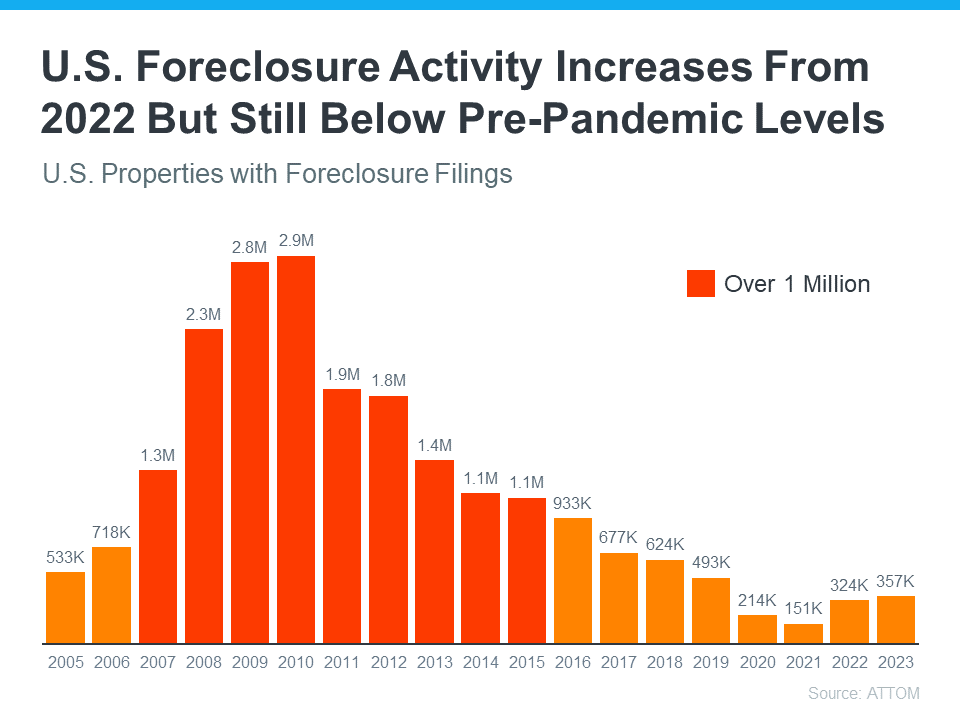
So, while foreclosure filings are up in the latest report, it’s clear this is nothing like it was back then.
In fact, we’re not even back at the levels we’d see in more normal years, like 2019. As Rick Sharga, Founder and CEO of the CJ Patrick Company, explains:
“Foreclosure activity is still only at about 60% of pre-pandemic levels. . .”
That’s largely because buyers today are more qualified and less likely to default on their loans. Delinquency rates are still low and most homeowners have enough equity to keep them from going into foreclosure. As Molly Boesel, Principal Economist at CoreLogic, says:
“U.S. mortgage delinquency rates remained healthy in October, with the overall delinquency rate unchanged from a year earlier and the serious delinquency rate remaining at a historic low… borrowers in later stages of delinquencies are finding alternatives to defaulting on their home loans.”
The reality is, while increasing, the data shows a foreclosure crisis is not where the market is today, or where it’s headed.
Even though the housing market is experiencing an expected rise in foreclosures, it’s nowhere near the crisis levels seen when the housing bubble burst. If you have questions about what you’re hearing or reading about the housing market, connect with a real estate agent.
Have you seen headlines talking about the increase in foreclosures in today’s housing market?